We earn a commission if you buy through our links, at no extra cost to you.
Best Standing Desk for Tall People: Height Range Guide
How to pick a standing desk for tall people: maximum height with and without the desktop, ANSI/BIFMA G1 height guidance, lift capacity and four models to compare.
At a glance
For the tallest stated range, the Vari ComfortEdge 60x30 lists 50 1/2 inches. The Desky Dual Hardwood lists 49.2 inches without the desktop and 330.7 lb capacity, and the Progressive Desk Solo Ryzer lists 49.1 inches. Add the top thickness before you compare.
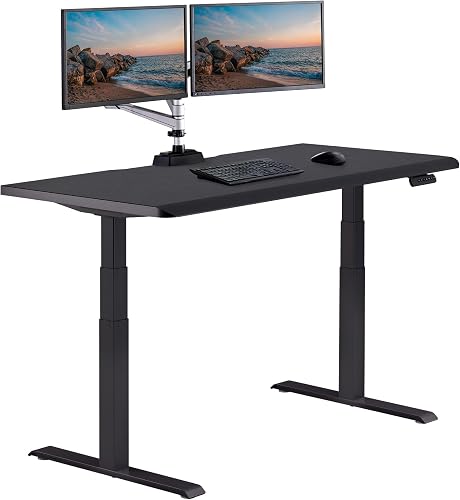


If you are tall, choosing a standing desk comes down to hardware numbers: how high the desktop surface can go, whether the brand’s range includes the top, how much weight the lift can carry and how steady the desk stays at full extension. This guide covers those points and compares four models from our lineup. The wider ranking is in our comparison of the best standing desks. We do not run our own product trials. Every figure below comes from the brands’ own pages and is listed in the sources at the end. Where a brand leaves a number out, we say so instead of guessing.
This product is not a medical device and does not replace advice from a healthcare professional. Read the manufacturer's instructions before first use.
What to Check First
Maximum Height: Frame or Finished Desk?
The headline height range on a spec sheet is not always the height of the finished surface. Some brands state the range for the legs alone, and the desktop then sits on top. Desky says its Dual Hardwood runs from 23.6 to 49.2 inches without the desktop. Uplift states a 22.6 to 48.7 inch range for its V3 frame. Vari lists 25 to 50 1/2 inches for the ComfortEdge and a maximum desk height of 50.5 inches in its spec table. Progressive Desk lists 23.6 to 49.1 inches for the Solo Ryzer. If a brand does not say whether its range includes the desktop, ask it before you order.
Desktop Thickness Adds to the Number
When the range is for the frame, the finished surface height is the frame height plus the thickness of the top. Uplift lists a 1 inch bamboo top, and Vari lists a 1 1/4 inch commercial-grade desktop. Whether the thickness adds to the stated maximum depends on whether the brand’s range excludes the top. Compare desks on the same basis, finished surface to floor, before you rank them.
ANSI/BIFMA G1 Height Guidance
BIFMA is the Business and Institutional Furniture Manufacturers Association, and ANSI/BIFMA G1 is a guideline on furniture dimensions for the workplace. Uplift says its V3 frame has a 22.6 to 48.7 inch range that meets the ANSI/BIFMA G1-2013 height guidance and fits 95% of users. That is Uplift’s claim. If you need a surface above the top of that range, look at frames with a taller ceiling, which is why we list the tallest ranges first below.
Measure Before You Compare
Measure the surface height you need from the floor, allowing for any keyboard tray, desk mat or monitor stand. Then compare that number with each desk’s finished surface height. We do not give a target number here, because the right value depends on your setup. Follow the manufacturer’s instructions for the controller and the height limits.
Lift Capacity and Stability at Full Extension
A taller desk is a longer lever, so the weight limit matters. The brands list these figures: Desky 330.7 lb, Progressive Desk 270 lb, Vari 200 lb. Uplift does not list a capacity on the page we read. Add up the desktop, monitors, arms, a laptop and anything on a shelf, and stay under the stated limit. Brands describe their frames as stable, but none of the pages we read give a sway measurement for the four desks here, so we make no claim about wobble.
Width and Depth
A deeper top lets monitors sit further back. The Vari is 60 by 30 inches, the Desky listing is 60 inches wide, and the Progressive Desk listing is 60 by 30 inches. Uplift offers widths from 42 to 80 inches at a depth of 30 inches. Make sure the legs will not interfere with your chair base.
Desks to Compare
Vari ComfortEdge 60x30: Highest Stated Ceiling
The tallest listed range in this guide at 25 to 50 1/2 inches, on a 60 by 30 inch top with a 1 1/4 inch desktop. Its capacity is 200 lb.
Vari lists a 25 to 50 1/2 inch range on 3-tier legs, a 200 lb weight capacity and a 1 1/4 inch commercial-grade desktop. The desk is UL962 listed and Vari says it meets or exceeds BIFMA standards. The warranty is lifetime and non-transferable, with a 30-day free return. Two trade-offs: the 200 lb limit is the lowest of the four, and the front edge slopes downward. Owner comments on Vari’s page say that edge does not suit everyone and rules out front-edge mounts. Details are in our Vari ComfortEdge profile.
Desky Dual Hardwood: Highest Stated Capacity
A 23.6 to 49.2 inch range without the desktop, dual motors and a 330.7 lb capacity, with a solid hardwood top that adds to the final surface height.
According to Desky, the Dual Hardwood has dual motors, 3-stage legs, a 330.7 lb capacity, memory presets and a motion noise of about 40 dB. The listing here is the White Ash 60 inch top on a Space Gray frame. Desky lists AFRDI certification (Cert #17617/1) and TÜV Rheinland, and a 10-year warranty. Because the range is stated without the desktop, add the top’s thickness when you compare it with the others. We do not quote a preset count. See the Desky Dual Hardwood profile.
Progressive Desk Solo Ryzer: Dual-Motor Option
A dual-motor, 3-stage desk with a 23.6 to 49.1 inch range, 270 lb capacity and 4 memory positions. This listing is the 60 by 30 inch Light Ash top.
Progressive Desk lists the same dual-motor frame across Solo Ryzer models, with collision detection, a child lock and a 15-year warranty. The maker page we read is for the MDF version, and the listing we link is the 60 by 30 inch Light Ash top on a black frame. Owner comments on that page mention adhesive cable ties that do not hold well, so plan on your own cable clips. Progressive Desk does not say on the page we read whether its range includes the desktop. See the Progressive Desk Solo Ryzer profile.
Uplift V3 Bamboo: Documented Height Guidance

A 22.6 to 48.7 inch frame range that Uplift says meets ANSI/BIFMA G1-2013 height guidance, with a 1 inch bamboo top and a 15-year warranty.
Uplift says the V3 frame needs no lower crossbar and goes together with one tool, and it includes a FlexMount Cable Manager. The 15-year warranty covers every desk in full plus most accessories, per Uplift. The ceiling of 48.7 inches is the lowest of the four, so it fits only if the finished surface height, with the top added, reaches the height you need. Uplift does not list a lift capacity on the page we read, so confirm it before you load the desk. See the Uplift V3 Bamboo profile.
Quick Comparison
| Desk | Stated height range | Capacity | Top | Warranty |
|---|---|---|---|---|
| Vari ComfortEdge 60x30 | 25 to 50 1/2 in. | 200 lb | 60 x 30 in., 1 1/4 in. | Lifetime |
| Desky Dual Hardwood | 23.6 to 49.2 in. without top | 330.7 lb | Solid hardwood, 60 in. | 10 years |
| Progressive Desk Solo Ryzer | 23.6 to 49.1 in. | 270 lb | 60 x 30 in. Light Ash | 15 years |
| Uplift V3 Bamboo | 22.6 to 48.7 in. | Not listed | 1 in. bamboo | 15 years |
Before You Order
Measure the surface height you need, then compare it with each desk’s finished surface height. Confirm that the listing names the exact size and finish, and compare its details with the brand’s page. Check the stated weight limit against everything you plan to put on the desk. Assemble the desk on a level floor, tighten all hardware and read the instructions before first use. To see all of our picks together, go to our standing desk comparison.
Sources
Frequently asked questions
What is the maximum height I should look for in a standing desk if I am tall?
There is no single number. Work out the surface height you need, then compare it with the maximum height the brand lists. Check whether that figure includes the desktop. If it does not, add the top's thickness.
Does the desktop thickness change the maximum height?
Yes, when the brand states the range for the frame alone. Desky states 23.6 to 49.2 inches without the desktop, so the hardwood top adds to that number. Vari lists 25 to 50 1/2 inches for a desk with a 1 1/4 inch top, so confirm with Vari whether the ceiling includes it.
What is ANSI/BIFMA G1?
It is a guideline on furniture dimensions. Uplift says its V3 frame has a 22.6 to 48.7 inch range that meets the ANSI/BIFMA G1-2013 height guidance and fits 95% of users, according to Uplift.
Which desk in this guide has the tallest listed range?
The Vari ComfortEdge 60x30, at 50 1/2 inches according to Vari. Desky lists 49.2 inches and Progressive Desk 49.1 inches. Uplift lists 48.7 inches.
Does a taller desk need a higher weight capacity?
Not necessarily, but capacity matters for what you put on the desk. Vari lists 200 lb, Progressive Desk 270 lb and Desky 330.7 lb. Add up the desktop, monitors, arms and equipment first.
Should I worry about wobble at full height?
Stability varies by frame and by load. Brands describe their frames, but none of the pages we read give a sway measurement. Keep the desk on a level floor, tighten all hardware and read the instructions.